Showing posts with label clouds. Show all posts

Saturday, January 21, 2012

Some wine beside the white clouds

Landscape can be a solace to the exile, but it can be hard to contemplate the beauty of lakes and mountains without thinking of home, or the bitter circumstances and long journey that have led from there.  When the An Lu-shan rebellion broke out in 756, the poet Li Po travelled south to Kiukiang to escape the turmoil and fighting.  There he made an ill-fated decision to join Prince Lin, the Emperor's sixteenth son, whose flotilla was making its way down the Yangtze.  Instead of heading off to fight the rebels, Prince Lin was aiming to set up his own independent regime.  According to Arthur Waley (in The Poetry and Career of Li Po) it seems unlikely that the rather unworldly Li Po knew what the Prince intended - he would later claim to have been virtually kidnapped: "I allowed myself to be deceived by false pretences and was forced by threats to go on board a transport."  At the time though, he wrote poems like 'Watching the dancing-girls at a banquet on board Marshal Wei's transport; written while with the Fleet', indicating that he was thoroughly enjoying himself on this adventure.  This pleasant time came to an end near Yangchow, where Prince Lin's forces were met by government troops and his generals abandoned him - Li Po probably jumped ship as well at this point (the prince was captured and executed).  On his return to Kiukiang, Li Po was arrested as a traitor and imprisoned for several months.  After being set free he made his way to Wu-ch'ang, near Hankow, where he stayed for a while, hoping for a pardon, before continuing again, north, to Yo-chou, near the famous Tung-t'ing (Dong-ting) Lake.  There he met two friends, both exiles like himself.  Chia Chih was a writer (he had actually composed the Emperor's deed of abdication in 756) and former Governor of Ju-chou who had been demoted after being judged to have fled south from the rebels too hastily. Li Yeh was a relative of Li Po's, banished to the south after being charged with perverting the course of justice.  One day, the three friends decided to take an evening boating excursion on the lake...

Hermit Fisherman on Lake Dong-ting, Wu Zhen, 14th century

'The bright moon, the autumn wind / the waters of Lake Dong-ting, / a lone swan, the falling leaves, a tiny skiff.'  Thus Chia Chih conveys the beauty and the underlying sadness of the occasion.  In his Anthology of Chinese Literature Stephen Owen provides translations of the poems that resulted from this outing.  Li Po 'wrote a series of five of his most famous quatrains celebrating the beauty of the moment.'  But Chia Chih's are 'every bit as memorable.  Both poets called to mind echoes of exile and death beyond the edges of the vast lake, places like Chang-sha, where the Han intellectual Jia Yi was banished.' Li Po imagines riding the currents in the water up into the night sky and buying 'some wine / beside the white clouds.'  In the centre of the lake there is a mountain called Jun-shan (the source for one of China's ten famous teas) which Li Po pictures on a 'mirror of jade' - the 'bright lake, swept calm and clear.'  Chia Chih describes more turbulent waters, swollen with autumn floods.  The friends let the waves guide their light boat, 'no care whether near or far.'

So in eight short poems we have a record of an evening in the autumn of 759, a moment of reflection before events, like waves on the lake, swept these men up again.  Climbing Pa-ch'iu Shan that autumn, Li Po glimpsed another fleet mustering and wrote in one of his poems of the rebel forces approaching Lake Tung-t'ing.  It was only near the end of the year that peace was restored to the Yangtze region and the poet was finally able to leave, making for Wu-ch'ang where he again expressed his hopes of one day being given a posting back in the capital.  But by this time Li Po knew that any such post would be his last.  He fell ill while traveling to Nanking and in 762 made his final journey to see the great calligrapher, Li Yang-ping near T'ai-p'ing.  Meanwhile Chia Chih had also made his way back and, a year later, on the accession of Emperor Tai-tsung, regained his former position, going on to serve as Vice Minister of War before his death in 772.  Li Po seems to have died at the home of Li Yang-ping, to whom the poet entrusted what writings he still had after his years of wandering in exile.  According to the well known story, he took another nighttime boat excursion, and this time, drunk on wine, fell into the river and drowned whilst trying to embrace the reflection of the moon.

Note: As always the sources vary in spelling Chinese words and here I've generally stuck to the older Wade-Giles system - for me the poet will always be Li Po rather than Li Bai.  The pinyin version of Chia Chih is Jia Zhi.  As noted above, Lake Tung-t'ing is now generally called Lake Dong-ting.

Tuesday, December 20, 2011

Iceberg in Mist

Between 1968 and 1970 Gerhard Richter painted a remarkable range of 'damaged landscapes', as they are termed by Mark Godfrey, the curator of Tate Modern's Gerhard Richter: Panorama. These include aerial views of cities in thick grey paint, the colour of ash and rubble, that Richter later likened to images of the destruction of Dresden but which might equally be seen as warnings of some future apocalypse.  One of these, Townscape Paris (1968), is a painting I referred to rather tentatively in one of my very first blog posts here.  At the same time Richter was also painting a very different kind of townscape, reproducing details of architectural models, and these too seem dystopian - windowless blocks showing no sign of life, casting shadows over empty white roads that resemble the patterns on a circuit board.
 

Another monochrome aerial view from 1968, Clouds, provides glimpses of an abtsracted version of the German countryside - imagery that Godfrey compares to the opening sequence (above) of Leni Riefenstahl's Triumph of the Will (1935). Two years later Richter began a very different series of cloud paintings, this time treating them as isolated objects, white against featureless blue-green skies.  They resemble Alfred Stieglitz's famous cloud photographs, Equivalents (1927), which in turn (as Rosalind Krauss points out in that weighty tome Art Since 1900) could be viewed as Duchampian readymades - uncomposed and detached from their environment.  Alps II (1968) might be a close-up of a storm cloud and is barely recognisable as a landscape painting, certainly a long way from the heroic image of German mountains celebrated in those early Reifenstahl films.

Seascape (Sea-Sea) (1970) is described in the exhibition as a 'collage of two photographs of the sea, one inverted to appear as the sky. The painting creates a momentary illusion of a coherent seascape, until it becomes clear that the ‘clouds’ in the upper half of the painting are waves. It creates a sense of discontinuity and suggests Richter’s acknowledgement of the gulf separating him from the moment of Romanticism.' It made me think of Rothko's grey paintings, with the patterns of waves replacing Rothko's brushtrokes.  Mark Godfrey views them as a cross between Capar David Friedrich and Blinky Palermo: an attempt at the kind of radical abstract statement Palermo was making in his Cloth Paintings using the traditional medium of a seascape.  Another point of comparison is Vija Celmins and, like her, Richter also produced images of black and white fields of stars.

In 1971 an exhibition of Richter's recent work, painted in flat colour rather than black and white, prompted various critics to compare him with Friedrich.  Landscape near Hubbelrath (1969), for example, shows an empty view with a road sign where we expect to see, in Friedrich, a church spire.  Richter said that his art lacked the spiritual underpinnings of Romanticism: 'for us, everything is empty'.  However, Mark Godfrey argues that Richter and Friedrich both aimed to create a sense of unfulfilled desire (readers of this blog may recall an earlier post on the way Friedrich composed 'obstructed views').  This approach may have seemed particularly appropriate to a post-war German artist working at a time when the purpose of painting itself was being called into question.

There is one more interesting example of Richter's engagement with Friedrich later in the exhibition, a painting called Iceberg in Mist (1982).  I have mentioned various artists here before who went north to paint the Arctic seas -  Peder Balke, Lawren Harris, Per Kirkeby - and Richter made his own trip in 1972, looking for a motif as powerful as Friedrich's The Sea of Ice.   Mark Godfrey mentions that on his return Richter made 'an extraordinary and little-known book of black and white photographs of icebergs', printed, like the two halves of Seascape (Sea-Sea), both upside down and right side up.  In this way Richter rejected the single sublime image and arranged the photographs in such a way that 'their overt subject became more or less irrelevant.'  Richter's urge to thwart our desire for spectacular landscapes is also evident in the later painting, where we cannot even glimpse the tip of the iceberg as the whole view is shrouded in mist.

Caspar David Friedrich, The Sea of Ice, 1823-4

Sunday, October 16, 2011

Cloud and light

Toshio Hosokawa's new opera Matsukaze, based on a Noh play by Zeami, has received a lot of praise this year.  The New York Times review explains that it begins with some field recordings: 'the tranquil sound of waves washing up on a beach, which he recorded off the coast near Tokyo in January. Two months later, when the cast assembled in Berlin to begin preparing for the opera’s premiere in Brussels, the waves had acquired an entirely different significance. “We heard those water and wind sounds, and we remembered at once the tsunami...”' 
Last month ECM issued a new set of Hosokawa recordings, Landscapes.  Despite the title this only includes one of his early 90s 'Landscape' chamber pieces (some of which are currently viewable on Youtube - see below).  It features a new expanded version of  'Landscape V' for shô and string orchestra; the other tracks are 'Sakura für Otto Tomek', 'Cloud and Light', and 'Ceremonial Dance'.  The Independent's Andy Gill pronounces the album 'exquisite' but The Guardian's Andrew Clements thinks it 'exquisite in a self-conscious way ... for a few minutes the effect is entrancing, but after that it begins to pall'.  In his liner notes Paul Griffiths says 'The interplay of shô and strings, and in particular their mutual imitation, is the driving force – or perhaps one should say ‘drifting force’, given that the music carries itself so lightly ...  its effect is of observing clouds in a largely peaceful sky, clouds that are mostly white but occasionally show shadows and briefly stir into more turbulent action.”

Saturday, July 16, 2011

Rome must be like the clouds


A reference to one of Joseph von Eichendorff's poems in that last post reminds me that I've not previously mentioned here one of my favourite Romantic Novellen, his 'Life of a Good-for-Nothing' (1826).  Its guileless hero makes his way to Italy... 'Eventually, when I had covered quite a distance, I gathered that I was only a few miles from Rome. This filled me with joy, for when I was a child at home I had heard many wonderful stories of the splendour of this city. As I lay on the grass outside the mill on Sunday afternoons and everything around was so quiet, I used to think that Rome must be like the clouds moving above me, with wonderful mountains and ravines going down to the blue sea, and golden gates, and tall gleaming towers on which the golden-robed angels were singing. Night had fallen long since, and the moon was shining brightly when I finally came out of the wood onto a hilltop and suddenly saw the city in the distance. The sea was glimmering far off, the immeasurable heavens were twinkling and sparkling with their countless stars, and below them lay the Holy City, of which only a long strip of mist was visible, like a sleeping lion on the quiet earth, while the hills stood round like dark giants watching over it.' (trans. F.G. Nichols)

He walks on over 'a wide, lonely heath' and on to the city where 'the tall palaces and gates and the golden cupolas gleamed in the bright moonlight.'  We have entered a Rome of the northern imagination here, with the same appeal as that dream image of 'Amerika' in Kafka's novel (which I quoted from here in an earlier post). Eichendorff's hero goes 'past a few small houses and then through a magnificent gate into the renowned city of Rome. The moon shone between the palaces and down into the streets as though it were broad daylight, but the streets were all deserted except for the occasional ragged fellow lyhng in a marble doorway in the warm night and sleeping like the dead. The fountains were plashing in the silent squares, and the gardens along the street were rustling and filling the air with refreshing scents.'  In Rome he encounters a painter and visits his studio in the attic of an old house, where we are given one of those images of the Romantic artist at the window I described yesterday. 'The painter flung the window open, so that the fresh morning air swirled through the whole room. There was a marvellous outlook over the city and towards the mountains, with the early sun shining on the white villas and vineyards. "Here's to our cool green Germany beyond those mountains!" cried the painter, drinking from the bottle he then passed to me. I responded to him politely and in my heart I thought again and again of my beautiful distant home.'

Wednesday, June 8, 2011

The Morning Glory

If I hadn't been so busy at work I might have tried to get to the Aubin & Wills Literary Salon this evening, where Travis Elborough was talking about his seaside book Wish You Were Here and Gavin Pretor-Pinney was due to discuss The Wavewatchers' Companion. Never mind - I was actually at the seaside watching the waves last week, and although I've not yet got round to either of these books, I did have Gavin Pretor-Pinney's earlier bestseller The Cloudspotter's Guide with me.  You can read various reviews and articles online that tell the story of The Cloud Appreciation Society, which Pretor-Pinney founded in 2004, and the writing and design of The Cloudspotter's Guide, rejected by 28 publishers before becoming a runaway bestseller.  The book is not a cultural history, although there are references to clouds in the work of Mantegna and Correggio, Kalidasa and Thoreau.  Keen not to be seen as too highbrow, the author describes himself wondering through the Tate's American Sublime exhibition with the catalogue upside down (his point being that the skyscapes in Bierstadt and Church are as important as the landscapes).  His sense of humour did grow on me - it is hard to resist the comparison of strato-cumulus, 'always in transition', with 'the pop singer Cher at the height of her costume-changing stage routines'.  One species of this cloud, the Morning Glory, is likened to Cher 'in the brass armour bikini and gold Viking helmet she wore on the sleeve of her 1979 album Take Me Home'.  This is a long way from Hubert Damisch and A Theory of /Cloud/, I thought, as I read this, but then Damisch was interested in the painted signifier, Pretor-Pinney in explaining and celebrating the real thing.

Altocumulus stratiformus translucidus I believe
(but feel free to correct me if I've got it wrong...)

The Cloudspotter's Guide includes a brief description of the Cloud Harp, an instrument designed by Nicolas Reeves that responds to the shape of the clouds above it (see video clip below), and in the chapter on stratus there is an account of the Blur Building, designed by Liz Diller and Ric Scofidio for the 2002 Swiss Expo, which took the form of a cloud floating on the surface of Lake Neuchâtel.  The design for this consisted of a metal skeleton covered with 31,400 high-pressure water jets controlled by computer which took account of temperature, humidity and prevailing winds.  'By responding dynamically to the constant changing atmospheric conditions, the system ensured there was always enough fog to envelop the structure, but not so much as to cause a nuisance downwind.'  Artificial clouds and the manipulation of weather for military ends are the depressing subject of the book's penultimate chapter.  A 1996 report for the US government, Weather as a Force Multiplier: Owning the Weather in 2025, describes a future in which an enemy can be hit with fog, rain, storms and lightning, and where clouds are controlled through nanotechnology and are able to communicate with each other.  After this it is a relief to turn to the final chapter, where Gavin Pretor-Pinney travels to a small town near the Gulf of Carpentaria in search of the Morning Glory (the cloud he likened to Cher in her brass bikini).  There he meets the glider pilots who surf this magnificent roll of cloud as it heads inland, and is taken up himself to see the morning sun cascading 'down the cloud's face, casting long shadows along the ripples of its surface.  The undulations gently rose up with the progress of the wave, before disappearing over the crest.'


Thursday, February 24, 2011

The bracing glories of our clouds


I have enjoyed reading Romantic Moderns, which has much to say about the revival of interest in the English landscape before and during the war.  Alexandra Harris acknowledges her debt to Kitty Hauser, whose Shadow Sites: Photography, Archaeology and the British Landscape, 1927-1955 begins with a discussion of the 'topophilia' characteristic of writers and artists in this period.  In 1947 Auden defined this topophilia as having 'little in common with nature love.  Wild or unhumanized nature holds no charms for the average topophil because it is lacking in history' (cf. Sebald vs. Mabey in my recent 'After Nature' post).  What unites 'topophils', Hauser writes, 'is an interest, sometimes amounting to an obsession, with local landscapes marked by time, places where the past is tangible.  For some, such as Betjeman, John Piper and Geoffrey Grigson, this topophilia - as Auden suggests - is eclectic, including medieval churches, Gothic and mock Gothic architecture, Regency terraces and ancient sites.  Some topophils of this generation, such as Paul Nash with his fascination with the genius loci, made atmospheric prehistoric landscapes a particular focus. Others, like painter Graham Sutherland, were attracted to scarred nature and geological vistas.  In the Four Quartets, T. S. Eliot looked for redemption and history in an English village: 'History is now and England'.  And with an eye to continental Surrealism, photographers and film makers including Bill Brandt, Humphrey Jennings, Michael Powell and Emeric Pressburger found in pockets of the British landscape curious and moody survivals from the past.' 

All of these writers and artists feature in Romantic Moderns, along with others less directly concerned with landscape but whose work looked nostalgically at a fast vanishing world of country houses and village traditions.  The Bright Young Things, for example - Evelyn Waugh, Cecil Beaton, Rex Whistler, the Sitwells -  whose work has never appealed much to me, are discussed alongside Eric Ravilious and Edward Bawden in an interesting chapter on the 1930s Georgian Revival.  Kathryn Hughes in The Guardian, praises the book's 'tactful generosity towards people and places, sights and sounds, that have tended to get written off as embarrassing or just plain wrong. Never has this seemed more important than now, as we work through our own complicated millennial feelings about the romance of the past. Thanks to Harris it no longer seems entirely shaming to admit to a secret Cath Kidston habit. Taking tea in the stable block of a National Trust property becomes a dignified activity, rather than something to pretend to find a chore.'

I'm no stranger to National Trust tea shops but have always been constrained in where I could go by not owning a car.  Motorists of the 1930s were encouraged to discover the landscape of Britian by the posters for Shell-Mex designed by artists like Vanessa Bell, Graham Sutherland and Frank Dobson (whose depiction of the Cerne Abbas giant is reproduced in Romantic Moderns - the giant's most famous feature is obscured by the shadow of a strategically placed cloud).  In 1934 Cyril Connolly titled his review of an exhibition of Shell-Mex commissioned artwork 'The New Medici'.  He observed that it was 'not the awe-inspiring or exceptional which now seems important, but what is most cheerful and genuine in our countryside - England is merry again - farewell romantic caves and peaks, welcome the bracing glories of our clouds, the cirrus and the cumulus, the cold pastoral of the chalk.'  The Shell County Guides that John Betjamen commissioned also looked beyond the obvious - a fact typified by John Piper's Oxon which deliberately excluded the city of Oxford.  As Alexandra Harris says, 'Piper's Oxfordshire is not a land of touristic sensation.  Old England is allowed to be almost a modern lived-in country.  A photograph of clustered advertisements which would have troubled purist preservationists is captioned 'a tree of knowledge', and an oval photograph with faded edges evokes nostalgia only to affront it with a big sign advertising a 'super cinema.''  It almost sounds like a journey through Oxfordshire's edgelands, prompting the thought that we could have a new series of county guides for the psychogeographically inclined pedestrian, written by Iain Sinclair, Rachel Lichtenstein, Patrick Keiller and so on.

Romantic Moderns won the Guardian First Book Award and Alexandra Harris can be seen talking about it on the Guardian website.  Thames and Hudson have now signed her up for two more books - a short biography of Virginia Woolf and another one, The Weather Glass, which I am looking forward to as it will apparently 'explore the British preoccupation with the weather, from Beowulf onwards'.  In Romantic Moderns these interests come together in a chapter called 'The Weather Forecast', where there is a discussion of Woolf's unfinished history of literature, 'Reading at Random'.  She makes this sound fascinating: it was to be a book 'shaped by views from windows and stretches of country ... a passionate exercise in literary geography.'  Harris argues that the twentieth century threatened to alienate people from the weather, as Modernist art looked beyond the incidentals of atmosphere to uncover clear cut shapes and colours.  She contrasts this with the rain-filled lithographs of her book's other main protagonist, John Piper (of whose drawings of Windsor George VI said, "You seem to have very bad luck with your weather, Mr. Piper").  Working outside, Piper 'loved the odd splashes that arrived unexpectedly in his paintings.'  These blots have the effect of confirming 'the allegiance between art and the world beyond the painting.  And, like the sand found in a half-read book, they are the souvenirs of a time and place, nature's signature added next to that of the artist.'

Thursday, December 23, 2010

A snowfall on the Esquiline Hill

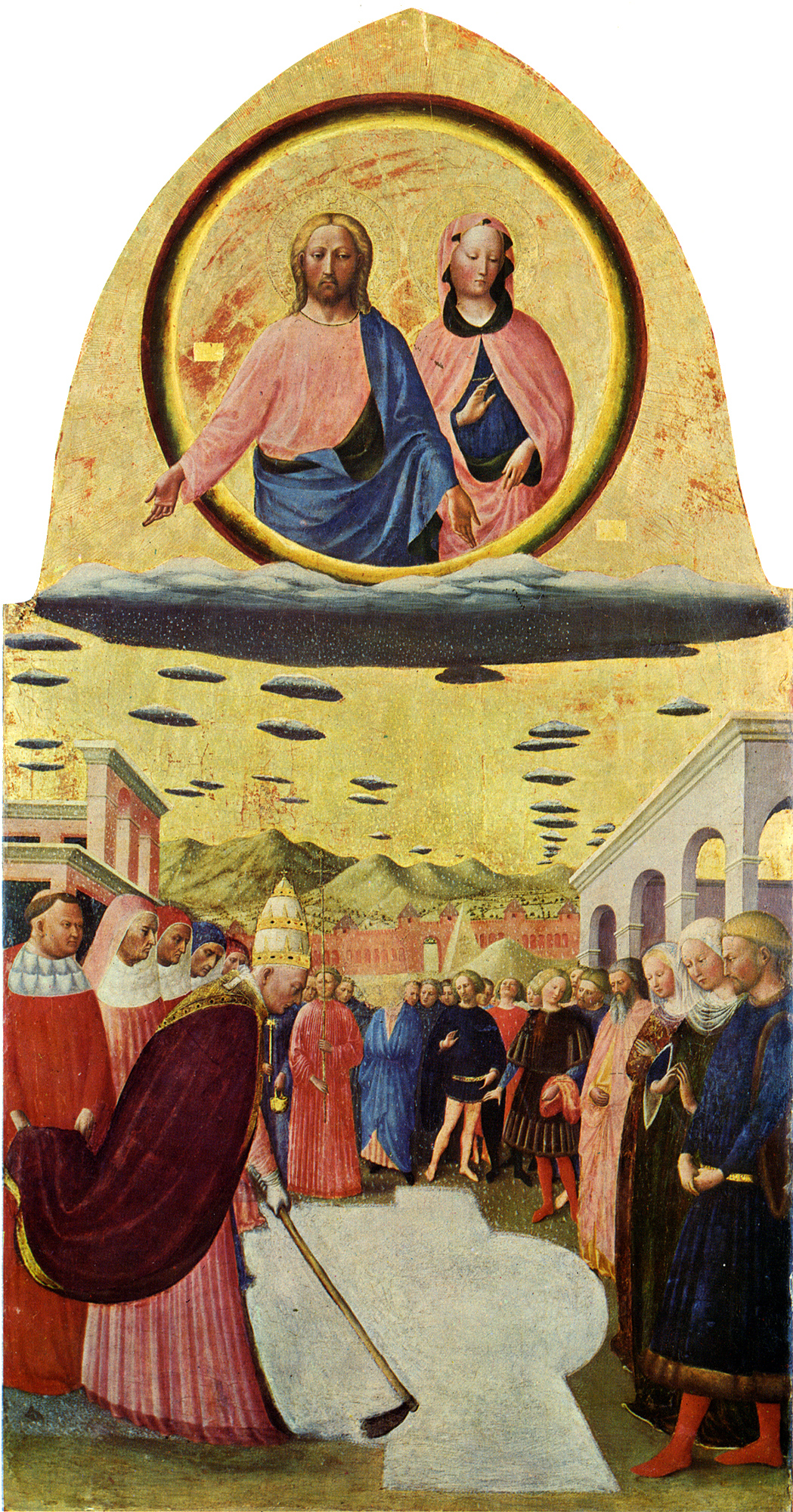
Masolino, The Foundation of Santa Maria Maggiore, c1427-8

The snow has been melting here and the passage of days has left Kline-like compositions on the ground mapping the departure of vehicles, the clearing of paths and the making of snowmen.  Looking out of the window now it is not clear why certain patches of snow remain, as if they have some special significance. Masolino's central panel for the Santa Maria Maggiore Polyptich shows Pope Liberius marking out the site of the future church after a miraculous summer snowfall on August 5th 352.  The snow had been predicted in a dream shared by the Pope and a rich Roman couple who wanted to donate their wealth to a worthy cause.  In Masolino's painting, snow floats through the golden sky beneath a fleet of clouds that resemble UFOs.  From the largest of them Christ and Mary look down and snowflakes fall more thickly on the place where the new building will rise, a permanent legacy of this fleeting phenomenon.  Later depictions of the legend by artists like Grünewald and Murillo treat the subject more naturalistically and less interestingly.  Today the miracle of the snow is recreated in Santa Maria Maggiore and other churches every year with a shower of flower petals.