Showing posts with label cities. Show all posts

Saturday, January 7, 2012

Apocalypse

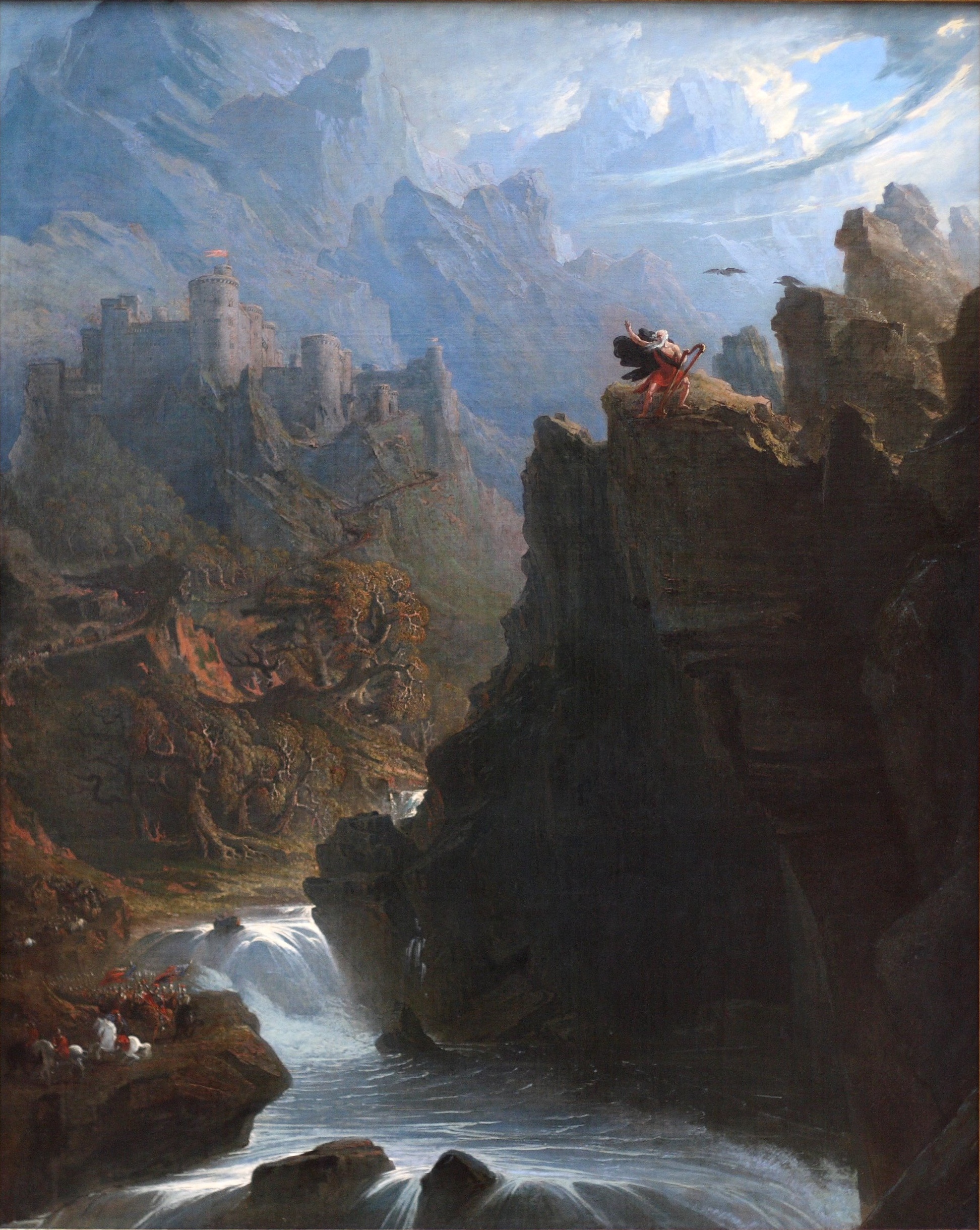
John Martin, The Bard, c1817

As the Tate Britain exhibition John Martin: Apocalypse comes to the end of its run, it would be interesting to know how well it has done.  There was talk beforehand of the way that Martin's critical reputation has risen and that his spectacular paintings should appeal in a world of 'proliferating IMAX cinemas and giant plasmas' (Ian Christie in Tate Etc. magazine) and contemporary photography framed on a Sublime scale - Edward Burtynsky, Florian Maier-Aichen, Andreas Gursky (Jonathan Griffin also in Tate Etc.)  The Tate's familiar Last Judgement Triptych was accompanied by a new 'theatrical display' intended to evoke the way these paintings were seen around the world in the late nineteenth century.  Looking round the exhibition I found it easy to see why John Martin's work has been mocked - "huge, queer and tawdry" was the verdict of William Makepeace Thackeray.  Martin's shortcomings are more evident when you see the paintings up close: The Bard for example often gets reproduced in books about Romanticism but I'd not previously been able to see how unconvincing some of its details are - Edward I's army a line of little tin soldiers trailing all the way back to the castle gate.  Yet there's still something awesome about these blockbuster paintings (at least that's what the adolescent Chris Foss fan I used to be was telling me) and the exhibition was also fascinating for the way it highlighted Martin's less well known activities - as a decorator of plates, an illustrator of prehistoric creatures (Gideon Mantell's The Wonders of Geology) and a painter of modest topographical water colours, like some views of Richmond Park where, like Edmund Spenser in Ireland, he had an oak tree named after him (how many writers and artists are commemorated in this way I wonder?)

Perhaps the most surprising exhibits were two examples of his schemes to improve the city of London.  The first, which might have been drawn by a 1970s land artist or a 1990s psychogeographer, was his plan for a London Connecting Railway - a beautiful curving form superimposed on a map, like the outline of an octopus.   The other was a drawing of a sewer housed in a new Thames embankment, stretching from 'the Ranelagh Outlet to the Engine Station': a proposal considered seriously at the time but easy to view as one more facet of Martin's capacity to dream up imaginary cities. (It made me think of today's urban explorers, uncovering tunnels like these and scaling buildings to view the city below from a John Martin perspective.)  An excellent article in The Guardian by the John Martin expert William Feaver mentions these engineering projects and claims that Martin 'was ecologically prophetic. In his 1833 A Plan for Improving the Air and Water of the Metropolis he raised an issue such as had been dismissed by the scoffers who ignored divine warnings and were swept away in Noah's flood: "Is it not probable that a too ignorant waste of manure has caused the richest and most fertile countries such as Egypt, Assyria, the Holy Land, the South of Italy etc to become barren as they now are?"'

John Martin, Pandemonium, 1841

Tuesday, December 20, 2011

Iceberg in Mist

Between 1968 and 1970 Gerhard Richter painted a remarkable range of 'damaged landscapes', as they are termed by Mark Godfrey, the curator of Tate Modern's Gerhard Richter: Panorama. These include aerial views of cities in thick grey paint, the colour of ash and rubble, that Richter later likened to images of the destruction of Dresden but which might equally be seen as warnings of some future apocalypse.  One of these, Townscape Paris (1968), is a painting I referred to rather tentatively in one of my very first blog posts here.  At the same time Richter was also painting a very different kind of townscape, reproducing details of architectural models, and these too seem dystopian - windowless blocks showing no sign of life, casting shadows over empty white roads that resemble the patterns on a circuit board.
 

Another monochrome aerial view from 1968, Clouds, provides glimpses of an abtsracted version of the German countryside - imagery that Godfrey compares to the opening sequence (above) of Leni Riefenstahl's Triumph of the Will (1935). Two years later Richter began a very different series of cloud paintings, this time treating them as isolated objects, white against featureless blue-green skies.  They resemble Alfred Stieglitz's famous cloud photographs, Equivalents (1927), which in turn (as Rosalind Krauss points out in that weighty tome Art Since 1900) could be viewed as Duchampian readymades - uncomposed and detached from their environment.  Alps II (1968) might be a close-up of a storm cloud and is barely recognisable as a landscape painting, certainly a long way from the heroic image of German mountains celebrated in those early Reifenstahl films.

Seascape (Sea-Sea) (1970) is described in the exhibition as a 'collage of two photographs of the sea, one inverted to appear as the sky. The painting creates a momentary illusion of a coherent seascape, until it becomes clear that the ‘clouds’ in the upper half of the painting are waves. It creates a sense of discontinuity and suggests Richter’s acknowledgement of the gulf separating him from the moment of Romanticism.' It made me think of Rothko's grey paintings, with the patterns of waves replacing Rothko's brushtrokes.  Mark Godfrey views them as a cross between Capar David Friedrich and Blinky Palermo: an attempt at the kind of radical abstract statement Palermo was making in his Cloth Paintings using the traditional medium of a seascape.  Another point of comparison is Vija Celmins and, like her, Richter also produced images of black and white fields of stars.

In 1971 an exhibition of Richter's recent work, painted in flat colour rather than black and white, prompted various critics to compare him with Friedrich.  Landscape near Hubbelrath (1969), for example, shows an empty view with a road sign where we expect to see, in Friedrich, a church spire.  Richter said that his art lacked the spiritual underpinnings of Romanticism: 'for us, everything is empty'.  However, Mark Godfrey argues that Richter and Friedrich both aimed to create a sense of unfulfilled desire (readers of this blog may recall an earlier post on the way Friedrich composed 'obstructed views').  This approach may have seemed particularly appropriate to a post-war German artist working at a time when the purpose of painting itself was being called into question.

There is one more interesting example of Richter's engagement with Friedrich later in the exhibition, a painting called Iceberg in Mist (1982).  I have mentioned various artists here before who went north to paint the Arctic seas -  Peder Balke, Lawren Harris, Per Kirkeby - and Richter made his own trip in 1972, looking for a motif as powerful as Friedrich's The Sea of Ice.   Mark Godfrey mentions that on his return Richter made 'an extraordinary and little-known book of black and white photographs of icebergs', printed, like the two halves of Seascape (Sea-Sea), both upside down and right side up.  In this way Richter rejected the single sublime image and arranged the photographs in such a way that 'their overt subject became more or less irrelevant.'  Richter's urge to thwart our desire for spectacular landscapes is also evident in the later painting, where we cannot even glimpse the tip of the iceberg as the whole view is shrouded in mist.

Caspar David Friedrich, The Sea of Ice, 1823-4

Friday, September 30, 2011

City Links

I used to imagine, sitting at a screen in the city, some kind of remote aural connection to a wild landscape.  Perhaps this is now possible - some durable, unobtrusive, solar-powered device hidden in the cliffs at Zennor for example, transmitting the sound of waves to my computer here.  As long ago as 1967 the composer and sound artist Maryanne Amacher set up microphones that could feed sounds back from five sites round the city of Buffalo.  Later she installed 'a microphone on a window overlooking the ocean at the New England Fish Exchange in Boston Harbour, transmitting the sound into her home studio continuously, sometimes using it as an element in other performances or exhibitions of City Links. “I would come in and it would be different according to different weather and changes,” Amacher told interview Leah Durner in 1989 ... She lived with the live transmission for three years. “I actually miss coming home to it,” she says now, some 20 years later.'  This quote comes from a 1999 Wire article; you can see a few photographs on the Maryanne Amacher Archive Project website (sadly it looks as if this has not been updated recently and a year ago they were asking for more funds).

It seems paradoxical to go to the trouble of listening to the world but played over the top of the 'real' soundscape surrounding you.  I wonder what John Cage thought of this?  Amacher worked with Cage on his Lecture on the Weather (0975), a composition 'for 12 speaker-vocalists (or instrumentalists), preferably American men who have become Canadian citizens, each using his own sound system given an equalization distinguishing it from the others ... The performance starts with the reading of the preface. In it Cage expresses his disgust with the institutions of American government. After that the work starts, the 12 men reading and singing text fragments by Henry David Thoreau, and/or play instruments (ad lib.). In part 1 this is accompanied by sounds (on tape) of wind and in part 2 by sounds of rain. In the third part the lights in the performance-space are dimmed and the performers are accompanied by the film and the sounds of thunder. The film consists of Thoreau drawings, printed in negative, the projection resembling lightning (white on black).'  Lecture on the Weather goes well beyond the simple notion of a soundscape.  It represents (in the words of Joan Retallack) a collision of political and environmental climates, like ' the complex chaotic condition of interpenetration and obstruction in which we live, a fragile balance of order and disorder, clarity and cacophony.'

Saturday, July 16, 2011

Rome must be like the clouds


A reference to one of Joseph von Eichendorff's poems in that last post reminds me that I've not previously mentioned here one of my favourite Romantic Novellen, his 'Life of a Good-for-Nothing' (1826).  Its guileless hero makes his way to Italy... 'Eventually, when I had covered quite a distance, I gathered that I was only a few miles from Rome. This filled me with joy, for when I was a child at home I had heard many wonderful stories of the splendour of this city. As I lay on the grass outside the mill on Sunday afternoons and everything around was so quiet, I used to think that Rome must be like the clouds moving above me, with wonderful mountains and ravines going down to the blue sea, and golden gates, and tall gleaming towers on which the golden-robed angels were singing. Night had fallen long since, and the moon was shining brightly when I finally came out of the wood onto a hilltop and suddenly saw the city in the distance. The sea was glimmering far off, the immeasurable heavens were twinkling and sparkling with their countless stars, and below them lay the Holy City, of which only a long strip of mist was visible, like a sleeping lion on the quiet earth, while the hills stood round like dark giants watching over it.' (trans. F.G. Nichols)

He walks on over 'a wide, lonely heath' and on to the city where 'the tall palaces and gates and the golden cupolas gleamed in the bright moonlight.'  We have entered a Rome of the northern imagination here, with the same appeal as that dream image of 'Amerika' in Kafka's novel (which I quoted from here in an earlier post). Eichendorff's hero goes 'past a few small houses and then through a magnificent gate into the renowned city of Rome. The moon shone between the palaces and down into the streets as though it were broad daylight, but the streets were all deserted except for the occasional ragged fellow lyhng in a marble doorway in the warm night and sleeping like the dead. The fountains were plashing in the silent squares, and the gardens along the street were rustling and filling the air with refreshing scents.'  In Rome he encounters a painter and visits his studio in the attic of an old house, where we are given one of those images of the Romantic artist at the window I described yesterday. 'The painter flung the window open, so that the fresh morning air swirled through the whole room. There was a marvellous outlook over the city and towards the mountains, with the early sun shining on the white villas and vineyards. "Here's to our cool green Germany beyond those mountains!" cried the painter, drinking from the bottle he then passed to me. I responded to him politely and in my heart I thought again and again of my beautiful distant home.'