Showing posts with label mountains. Show all posts

Tuesday, December 20, 2011

Iceberg in Mist

Between 1968 and 1970 Gerhard Richter painted a remarkable range of 'damaged landscapes', as they are termed by Mark Godfrey, the curator of Tate Modern's Gerhard Richter: Panorama. These include aerial views of cities in thick grey paint, the colour of ash and rubble, that Richter later likened to images of the destruction of Dresden but which might equally be seen as warnings of some future apocalypse.  One of these, Townscape Paris (1968), is a painting I referred to rather tentatively in one of my very first blog posts here.  At the same time Richter was also painting a very different kind of townscape, reproducing details of architectural models, and these too seem dystopian - windowless blocks showing no sign of life, casting shadows over empty white roads that resemble the patterns on a circuit board.
 

Another monochrome aerial view from 1968, Clouds, provides glimpses of an abtsracted version of the German countryside - imagery that Godfrey compares to the opening sequence (above) of Leni Riefenstahl's Triumph of the Will (1935). Two years later Richter began a very different series of cloud paintings, this time treating them as isolated objects, white against featureless blue-green skies.  They resemble Alfred Stieglitz's famous cloud photographs, Equivalents (1927), which in turn (as Rosalind Krauss points out in that weighty tome Art Since 1900) could be viewed as Duchampian readymades - uncomposed and detached from their environment.  Alps II (1968) might be a close-up of a storm cloud and is barely recognisable as a landscape painting, certainly a long way from the heroic image of German mountains celebrated in those early Reifenstahl films.

Seascape (Sea-Sea) (1970) is described in the exhibition as a 'collage of two photographs of the sea, one inverted to appear as the sky. The painting creates a momentary illusion of a coherent seascape, until it becomes clear that the ‘clouds’ in the upper half of the painting are waves. It creates a sense of discontinuity and suggests Richter’s acknowledgement of the gulf separating him from the moment of Romanticism.' It made me think of Rothko's grey paintings, with the patterns of waves replacing Rothko's brushtrokes.  Mark Godfrey views them as a cross between Capar David Friedrich and Blinky Palermo: an attempt at the kind of radical abstract statement Palermo was making in his Cloth Paintings using the traditional medium of a seascape.  Another point of comparison is Vija Celmins and, like her, Richter also produced images of black and white fields of stars.

In 1971 an exhibition of Richter's recent work, painted in flat colour rather than black and white, prompted various critics to compare him with Friedrich.  Landscape near Hubbelrath (1969), for example, shows an empty view with a road sign where we expect to see, in Friedrich, a church spire.  Richter said that his art lacked the spiritual underpinnings of Romanticism: 'for us, everything is empty'.  However, Mark Godfrey argues that Richter and Friedrich both aimed to create a sense of unfulfilled desire (readers of this blog may recall an earlier post on the way Friedrich composed 'obstructed views').  This approach may have seemed particularly appropriate to a post-war German artist working at a time when the purpose of painting itself was being called into question.

There is one more interesting example of Richter's engagement with Friedrich later in the exhibition, a painting called Iceberg in Mist (1982).  I have mentioned various artists here before who went north to paint the Arctic seas -  Peder Balke, Lawren Harris, Per Kirkeby - and Richter made his own trip in 1972, looking for a motif as powerful as Friedrich's The Sea of Ice.   Mark Godfrey mentions that on his return Richter made 'an extraordinary and little-known book of black and white photographs of icebergs', printed, like the two halves of Seascape (Sea-Sea), both upside down and right side up.  In this way Richter rejected the single sublime image and arranged the photographs in such a way that 'their overt subject became more or less irrelevant.'  Richter's urge to thwart our desire for spectacular landscapes is also evident in the later painting, where we cannot even glimpse the tip of the iceberg as the whole view is shrouded in mist.

Caspar David Friedrich, The Sea of Ice, 1823-4

Friday, November 4, 2011

The waving moorland and the level beach

I have been listening to the audiobook of The Woman in White, read by Ian Holm (whose voice always takes me back to childhood memories of the Radio 4 adaptation of Lord of the Rings).  The novel begins with the narration of a drawing master, who is distracted from the landscape by the beauty of one of the young ladies he is supposed to be teaching. 'The most trifling of the questions that she put to me, on the subject of using her pencil and mixing her colours; the slightest alterations of expression in the lovely eyes that looked into mine with such an earnest desire to learn all that I could teach, and to discover all that I could show, attracted more of my attention than the finest view we passed through, or the grandest changes of light and shade, as they flowed into each other over the waving moorland and the level beach.'  There follows an interesting passage on Art and Nature which I thought I would quote here in full.  You could contrast the closing sentences with the way other writers have taken comfort in the thought that it is the landscape that will outlast humanity (see, for example, my earlier post on Robinson Jeffers).
'At any time, and under any circumstances of human interest, is it not strange to see how little real hold the objects of the natural world amid which we live can gain on our hearts and minds? We go to Nature for comfort in trouble, and sympathy in joy, only in books. Admiration of those beauties of the inanimate world, which modern poetry so largely and so eloquently describes, is not, even in the best of us, one of the original instincts of our nature. As children, we none of us possess it. No uninstructed man or woman possesses it. Those whose lives are most exclusively passed amid the ever-changing wonders of sea and land are also those who are most universally insensible to every aspect of Nature not directly associated with the human interest of their calling. Our capacity of appreciating the beauties of the earth we live on is, in truth, one of the civilised accomplishments which we all learn as an Art; and, more, that very capacity is rarely practised by any of us except when our minds are most indolent and most unoccupied. How much share have the attractions of Nature ever had in the pleasurable or painful interests and emotions of ourselves or our friends? What space do they ever occupy in the thousand little narratives of personal experience which pass every day by word of mouth from one of us to the other? All that our minds can compass, all that our hearts can learn, can be accomplished with equal certainty, equal profit, and equal satisfaction to ourselves, in the poorest as in the richest prospect that the face of the earth can show. There is surely a reason for this want of inborn sympathy between the creature and the creation around it, a reason which may perhaps be found in the widely-differing destinies of man and his earthly sphere. The grandest mountain prospect that the eye can range over is appointed to annihilation. The smallest human interest that the pure heart can feel is appointed to immortality.'
- Wilkie Collins, The Woman in White, 1860
William Collins, the father of Wilkie Collins, 
Children on a Mountain Top, before 1847

Friday, October 21, 2011

The Jack Pine

Painting Canada: Tom Thomson and the Group of Seven is another superb exhibition at Dulwich Picture Gallery, following others I've described on this blog: Salvator Rosa, Paul Nash, Adam Elsheimer.  Reviewers (like Brian Sewell) will inevitably have to provide some background information on the Group of Seven, whose work has not often been seen in the UK.  In Canada, as Ian A. C. Dejardin says in the catalogue, their work has been endlessly discussed 'to the point of exhaustion.  Yet their visual legacy remains supremely powerful: many Canadians, raised with reproductions of the Group of Seven's most famous paintings on their classroom walls, still see their own country through the Group's eyes ... Few of us in Europe could point more than vaguely on a map to any of the locations these artists depicted.  These are painted woods, trees, lakes and mountains only.  Nonetheless, non-Canadians should be aware: we are on holy ground.'  As I know some readers of this blog are Canadian (see comments on my last post...) I'd better admit that a lot of these paintings were completely new to me.  

Tom Thomson in Algonquin Provincial Park, 1914-16
Source (all images here): Wikimedia Commons 

At the start of the exhibition, there is a quotation from Fred Housser, who wrote the first book about the Group of Seven in 1926: "This task [of expressing the spirit of the Canadian landscape in paint] demands a new type of artist; one who divests himself of the velvet coat and flowing tie of his caste, puts on the outfit of the bushwacker and prospector; closes with his environment; paddles, portages and makes camp; sleeps in the out-of-doors under the stars; climbs mountains with his sketch box on his back."  The idea of an artist who 'closes with the environment' reminds me of recent British land artists who have walked in Algonquin Park and other landscapes explored by the Group of Seven.


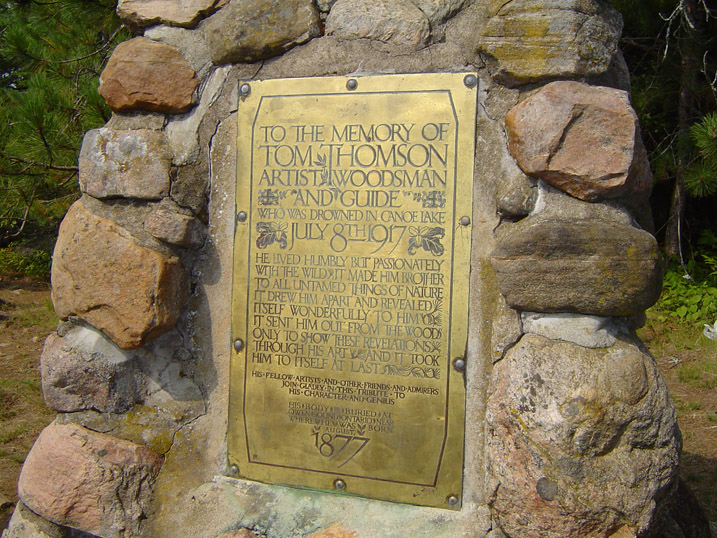
When Tom Thomson died in 1917, his memorial described him as 'artist woodsman and guide'.  Photographs show him fishing and canoeing; one of these was the basis for Peter Doig's White Canoe (1992) (see also my earlier post on Doig's Figure in a Mountain Landscape paintings).  However, as Dejardin points out in the catalogue, Thomson was actually rather a snappy dresser when out and about in Toronto and he made a point of adding some expensive cobalt blue to the marine grey used in painting his canoe.  In 1919 the wealthiest of the group, Lawren Harris, had a boxcar fitted out as a travelling studio for a trip north on the Algoma Central Railway.  It sounds more comfortable than the floating studios of the Impressionists, but this didn't detain some of the artists: as A. Y. Jackson observed, sitting in the boxcar, 'the other chaps are all out sketching under umbrellas.  They are all trying to turn out four a day and can't stop if it rains.'

 Tom Thomson, The Jack Pine, 1916

Tom Thomson's most famous paintings, The Jack Pine and The West Wind, are shown alongside their original sketches in the exhibition's first room.  Each is a majestic landscape visible behind the drooping form of a pine tree, its branches seemingly surrounded by a faint aura.  Pine trees seem to have inspired poets and artists all over the world so it seems surprising in retrospect that (according to Housser) the Canadian artistic establishment, unable to see beyond European and Hudson River landscape visions, considered their native Jack Pine trees unpaintable before Thomson came along.  There is a Pine Island in Georgian Bay (part of Lake Huron) and this exhibition includes two 1914 sketches of it by Thomson and a night scene by Jackson, where the trees stand over a pool of deep blue in which you can see the reflections of stars.
 
Six of the Group of Seven, plus their friend Barker Fairley, in 1920
From left to right: Frederick Varley, A. Y. Jackson, Lawren Harris,
Fairley, Frank Johnston, Arthur Lismer, and J. E. H. MacDonald.

In 1925 a critic noted that the Group had been 'tree mad', but also, successively, 'lake-lunatic, river-ridden, birch-bedlamed, aspen addled, and rock-cracked.  This year they are mountain mad.'  The exhibition's room of mountain views includes Frederick Varley's Hodleresque The Cloud, Red Mountain (1927-8) and Lawren Harris's stylised, almost art deco Mt Lefroy (1930), although I preferred the more direct, less abstract approach of J. E. H. MacDonald, especially a view of a small turquoise lake in the gathering snow with the Japanese-sounding title, Mountain Solitude (Lake Oesa) (1932).  The final room collects more of Harris's Theosophically-inspired landscapes from the late twenties - radically simplified mountains and ice bergs under grey skies, sometimes parted with shafts of light, reflecting his search for those 'moments in the North when the outward aspect of nature becomes for a while full luminous to her informing spirit - and man, nature and spirit are one.'

Thursday, July 28, 2011

Take a Look

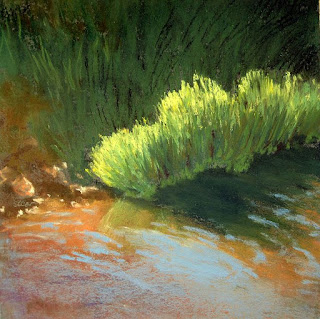
I've been painting in soft pastel for over 25 years. Long story short: no room to paint in pastels and an urge to move on. (God given!) I have a staggering pile of over 250 pastel paintings ~ credible, beautiful, fun artwork, bagged up and hidden away in the dark of my art cabinet. Take a look: Paintings for a Song


Corrales Acequia, 9" x 9"

Colorado Contrasts, 9" x 9"

Saturday, May 21, 2011

The Mountain That Had to Be Painted

Contemporary artist Iwan Gwyn Parry tackling Arenig in
'The Mountain That Had to Be Painted'

This week I've been unable to do more than collapse in front of the TV after long days at work, so I have appreciated the fact that BBC4 has been showing a Landscape Season.  There has been a lot of outdoor stuff - lakes (Wainwright), mountains (Munro), the golden age of canals and even a documentary on the A303 ('Highway to the Sun').  They repeated Alice Roberts 'titillating middle-aged men' (according to The Guardian) with her wild swimming, and in 'The Great Outdoors' they took 'a nostalgic look at life for campers, twitchers, ramblers and metal detectors'.  I missed the programme on R. S. Thomas (on too late...) but caught another one set in the Welsh landscape, 'The Mountain That Had to Be Painted'.  This was an account of the time Augustus John and James Dickson Innes spent in the Arenig Valley painting 'a body of work to rival the visionary landscapes of Matisse.'  Whilst it did little to dispel the impression that Auguston John's life is more interesting than his art, the programme provided a valuable introduction to the work of Innes, who died (like some old country singer) at the age of 27 from a mixture of TB and wreckless living.  For more on Innes and the Arenig school, see a recent post on the Footless Crow mountain writing blog. 

Earlier in the week there was an hour-and-a-half long history of English landscape painting, 'This Green and Pleasant Land.'  The programme discussed a sequence of paintings from the time of Charles I (Rubens and Van Dyck) down to World War Two (Paul Nash and the patriotic posters of Frank Newbould), with a final leap forward to David Hockney's recent iPhone sketches. As it started we wondered who the extraordinarily plummy-voiced narrator was - Brian Sewell my wife thought, but it turned out to be Simon Callow.  Fearing a rather conservative survey we nevertheless ended up enjoying the eclectic mixture of people they had invited to talk about each painting - from the 'editor at large' of Country Life, who suggested that Gainsborough's Mr and Mrs Andrews could easily be imagined in his magazine today, dressed in Barbour jackets and Hunter wellies, to a foundry manager who said he had a reproduction of Coalbrookdale by Night hanging up at home in the hallway.  It was worth enduring Peter York explaining his fascination for Atkinson Grimshaw in order to see John Virtue discussing Constable and sketching the sea. Will Self was on amusing form recalling the horror of growing up, as the son of a theoretician of garden suburbs, while actually living in a garden suburb ("that'll do things to a child!").  The programme generally covered the key works you would expect, although I was surprised they missed out Samuel Palmer and spent so much time on Stubbs (who I see I've never mentioned here).  All in all, well worth watching if you have access to the BBC iPlayer - available for 6 more days as I write this...
 
 Will Self discusses William Ratcliffe's