Showing posts with label snow. Show all posts

Monday, December 26, 2011

Winter Journey


It is ten years since the untimely death of W. G. Sebald and earlier this month there was a special event to celebrate his work and launch Across the Land and the Water: Selected Poems, 1964-2001. There were contributions from Iain Sinclair, A. S. Byatt, Andrew Motion and others who knew him (like poet Will Stone, whose recollections of studying with Sebald were particularly poignant).  It was sad to reflect that the last time I had seen translator Anthea Bell on stage it was next to Sebald himself, reading from the recently-published Austerlitz.  The crumbling Victorian Wilton's Music Hall was a particularly resonant setting for the readings, and for the performance of songs from Schubert's Winterreise by Ian Bostridge.  Hearing the Winterreise in this context prompted thoughts of all the journeys and sadness in Sebald's writings.  

There are many clips online of Ian Bostridge performing the Winterreise - the one I've included above is the opening song in the sequence.  I thought it would be interesting to provide here short summaries of the cycle's twenty-four songs, to show how many of them start with some aspect of the winter landscape - the rustling sound of linden trees, ice on a frozen river, a tree's last few leaves trembling in the wind.  Many of these natural elements are evoked in Schubert's piano score (for example, in 'Der Lindenbaum', 'the piano’s fluttering triplet figuration in E major which opens the song evokes the gentle breezes and whispering leaves of summer: the figure returns later, altered with chromatic harmonies, to depict the cold wind and eerie rustling of the tree in winter, and the young man’s growing sense of delusion'.)  Rather than do a plain synopsis I've turned the Winterreise below into a set of tanka-style verses - I know this is a complete travesty (as Mrs Plinius was quick to point out when she saw what I was doing) but I just found it more fun than writing a set of bullet points... I've based this on the English translation at the Lied, Art Song and Choral Text Archive, using Arthur Rishi's titles; you can follow the link to read proper translations, or the original German poems by Wilhelm Müller. 
Good Night

I leave, a stranger -
Remembering the flowers
And the talk of love
As I walk this path in snow
And write “Good Night” on thegate.

The Weathervane

The weathervane blows
Whistling at this fugitive.
In that house, the wind
Plays quietly withpeople’s hearts.
What is my suffering tothem?

Frozen tears

Frozen teardrops fall
Like morning dew turned toice
But spring from a heart
That’s burning hot enoughto
Melt all the ice of winter.

Numbness

No trace of her now
Walking on this once greenfield.
Pale turf, dead flowers.
And if my dead heartshould thaw,
Her image would melt away.

The linden tree

By a fountain, near the gate:
A linden tree. Though it’s dark
I try not to see
The words of love we carvedthere.
Still, I hear the tree rustling.

Torrent

The snow drinks my tears,
But when the grass starts to grow
And the ice breaks up
A brook will carry them through
The town’s streets and past herhouse.
On the stream

Wild stream, with a hard
Solid crust of ice onwhich
I carve her name, and
A broken ring.  Underneath
There is a surgingtorrent.

Backward Glance

I’ll not pause until
The town is out of sightwhere
Once the windows shone,
The linden trees wereblooming
And a girl’s eyes wereglowing.

Will-o'-the-wisp

A will-o'-the-wisp
Led me astray. Now I walk
Down a stream’s drycourse.
Every stream will find the sea,
Every sorrow finds its grave.

Rest

Too cold to stand still
I’ve walked this desolateroad.
Sheltering now in
A coal burner’s narrow hut
I cannot rest, my woundsstill burn.

A Dream of Springtime

Dreaming of flowers
And the song of birds inMay,
I wake in the dark
With ravens shriekingabove.
When will all these leavesturn green?

Loneliness

A dark cloud passing
Through clear skies, I make myway
Through bright, joyful life.
When the tempests were raging
I was not so miserable.

The post

What makes my heart leap
At the sound of a posthorn
Coming from the street?
Why would I want to look there?
There is no letter for me.

The grey head

My frost coated hair
Soon thaws and leaves megrieving,
Sad to think that death
Is still far off.  This journey
Has still not turned my hair togrey.

The crow

A crow is circling.
It’s been with me since the town
And won’t leave until
The end.  Not much further now.
Fidelity to the grave.

Last hope

A few coloured leaves
Are visible on the trees.
If that one I choose
Is caught and blown to the ground
I too will sink down and weep.

In the village

The hounds are barking
Whilst men sleep and dream ofthings
They do not have. Bark
Me away, you waking dogs.
I am finished with all dreams.

The stormy morning

Weary shreds of cloud
Flit across a storm-torn sky,
Red flames among them.
This morning is to my taste -
It is nothing but winter.

Deception

Before me a light…
I follow it eagerly
Through the ice and night
Imagining a warm house…
But it is all delusion.

The signpost

I search hidden paths
Over cliff tops and wastelands -
One sign before me,
My eyes fixed upon the road
From which no one returns

The inn

I reach a graveyard,
Its death wreaths tempting to
The weary traveller.
But all the rooms are taken
And I must go further on.

Courage

Snow flies in my face.
I shake it off.  My heart cries,
But I sing brightly.
I have no ears for laments
And stride on against thewind.

The phantom suns

Three suns in the sky
They seem to stare down atme.
Gone, the best two suns,
And I do not need thethird:
I’m better left indarkness.

The hurdy-gurdy man

Barefoot on the ice,
An old hurdy-gurdy man.
Nobody listens.
Shall I go with him and let
Him play along to my songs?

Friday, October 7, 2011

To go out and walk far in the forest

Badelunda, Sweden

I was glad to hear that Tomas Tranströmer has won the Nobel Prize and have been looking today through my copy of his New Collected Poems, translated by Robin Fulton.  Here is my guide to some of the imagery you'll find in his poetry.
    1. Snow.   In an earlier post I talked about a poem, 'From March 1979', in which Tranströmer goes to a snow-covered island and sees in the tracks of the deer 'language but no words.'  Language itself suffers in the still, cold February of another poem, 'Face to Face', where there is deep snow and 'footprints grew old out on the crust. / Under a tarpaulin language pined.'  But the onset of a snowfall can seem as joyful as music ('C Major') and when winter ends eventually, as in the poem 'Noon Thaw', the world has a new language: 'the vowels were blue sky and the consonants were black twigs and the speech was soft over the snow.'
    2. Stillness.   In that dead winter of 'Face to Face', 'living stood still' and 'the soul / chafed against the landscape.'  But eventually, one day, colours flared and 'everything turned around. / The earth and I sprang towards each other'. Elsewhere in Tranströmer there are moments of quiet contemplation, 'Weather Picture' for instance, where the October sea glistens coldly and all sounds are 'in slow flight'.  'Breathing Space July' contains three moments of stillness, lying under a tree, looking into the water, and sleeping.  And in 'Slow Music' he writes of a day down by the water, 'among large stones with peaceful backs', where 'you can stand in the sun with your eyes shut / and feel yourself being slowly blown forward.'
    3. Summer.   In a prose poem, 'The Blue House', Tranströmer stands ina dense forest under 'a night of radiant sun.'  'A ship's engine far away on the water expands the summer-night horizon.  Both joy and sorrow swell in the dew's magnifying glass.'  But those sunlit Swedish summers will eventually fade until the sounds of the forest flow 'into a single melancholy murmer' ('The Cuckoo'). In 'Lament' the writer notices the slow coming of night. 'The moths settle on the window pane: / small pale telegrams from the world.'
    4. Song.   In 'Song' Tranströmer recalls the legend of Väinämöinen, the eternal bard of the Kalevala, riding over the sea.  He also listens at nightfall to the abortive music of gulls on a dark skerry.  You can hear birdsong in many of his poems - 'Ringing', 'Morning Birds', 'Memories Look at Me', 'Early May Stanzas', 'The Nightingale in Badelunda'. The last of these describes a moment when time stopped as he listened to 'the raw resonant notes that whet the night sky's gleaming scythe.' 
    5. Stars.  'Orion hangs above the ground-frost...'; 'Silent constellations.  And the cold ocean.' Tranströmer poems often take place at night, although the stars may merely be glimpsed, up through the grating of winter.  In an early poem, 'Epilogue', he describes the evening star like an X-ray, developing a hidden landscape of houses, trees and fences.  And then a storm comes in and the stars seem to signal for help, 'lit and quenched by headlong clouds / that only when they shade the light betray / their presence.'
    6. Sleep.   In 'Tracks' a train stops in the middle of a plain - 'bright moonlight, few stars' - and far away there are the lights of a town.  It is like a dream that the sleeper will not remember. Sleep and dreams recur throughout Tranströmer's poetry and indeed the opening lines of the first poem in his first collection describe that moment of awakening when 'consciousness can grasp the world / as the hand grips a sun-warmed stone.'  'The Man who Awoke with Singing over the Roofs' evokes that same feeling, when the sleeper 'begins / groping for attention's instruments'. 
    7. Storms.  Sometimes the poet is woken by a storm.  In 'Autumnal Archipelago' he listens in the darkness to 'constellations stamping inside their stalls, high over the tree-tops'.  Similarly, 'A Winter Night' begins with this memorable image: 'the storm put its mouth to the house / and blows to produce a note.'  These experiences suggest a simile in 'Agitated Meditation': 'a storm drives the mill sails wildly round / in the night's darkness, grinding nothing. - You / are kept awake by the same laws...'
    8. Silence.   Other times the nights are quiet: in 'Nocturne', the trees keep 'silence in concord with each other.'  In 'Five Stanzas to Thoreau', Tranströmer talks of silence slowly spiralling from the earth to grow 'with its burgeoning crown to shade his sun-heated doorstep.'  Thus silence seems sought after at times - in 'Along the Radius' he sits by an ice-bound river on an upturned boat 'swallowing the drug of silence'.  But in 'April and Silence' Spring lies desolate and 'the only thing I want to say / glitters out of reach / like the silver / in a pawnbrokers.'
    9. Solitude.   In 'Alone', Tranströmer says 'I must be alone / Ten minutes in the morning / and ten minutes in the evening / without a programme.'  Earlier in this poem he is walking on the frozen fields of Östergötland and doesn't see a single person.  Other solitary artists appear in his poems - Thoreau 'disappearing deep in his inner greenness' and Grieg in his work-cottage, 'shut in with silence.'  In 'Solitary Swedish Houses' everything seems to stand alone and summer comes with 'flaxen-haired rain / or one solitary thunder-cloud / above a barking dog.'
    10. Sunlight.  Finally, the transformative effect of sunlight is evident in poems like 'Landscape with Suns', where the poet takes the memory of a glowing sun back to 'the half dead grey forest /  where we have to work and live.'  'Further In' describes an evening when he is driving through thick traffic.  A low red sun streaming in through his windscreen makes him feel transparent, so that 'writing becomes visible / inside me'.  Right then, he knows he must 'get far away / straight through the city and then / further until it is time to go out / and walk far in the forest.'

      Sunday, May 1, 2011

      The region appeared to be smiling

      Robert Walser's novel The Assistant (1908) opens on a spring morning as Joseph Marti knocks on the door of a lakeside villa owned by his new employer, the inventor Carl Tobler, and ends the following winter with his departure, leaving Tobler's family mired in debt and contemplating the inevitable sale of their property. In the afterword to her translation Susan Bernofsky says that the book's last paragraph was trimmed before publication, but that the original ending encapsulates 'the mood of the book's final pages in a poignant vignette in which the landscape that has been granted such powers of expression throughout the novel appears as lost in thought as its observer.'  Joseph looks back at the house one more time, 'silent in wintry isolation ... The landscape appeared to have eyes, and it appeared to be closing them, filled utterly with peace, in order to reflect.  Yes, everything appeared a bit pensive.  All the surrounding colors appeared to be gently and sweetly dreaming.'


      The landscape's 'powers of expression' are evident almost every time Joseph leaves the workshop and experiences the natural beauty around him.  These exaggerated examples of the pathetic fallacy read as the imaginative projections of a lonely young man, unsure of his place in this world and witnessing the hopes of his employer sinking into inevitable failure. 'Yes, you tell yourself, colors like this produce warmth!  The region appeared to be smiling, the sky seemed to have been made happy by its own appearance, it appeared to be the scent and substance and the dear meaning of this smiling of land and lake.  How all these things could just lie there, radiant and still.  If you gazed out over the surface of the lake, you felt - and you didn't even have to be an assistant for this - as if you were being addressed with friendly, agreeable words.'

      Joseph stays on at the villa despite not receiving his salary, unable to bring himself to leave.  But, he reflects, nature itself never really changes - lakes do not suddenly transform themselves into clouds.  'A wintry image could superimpose itself upon the world of summer; winter could give way to spring, but the face of the earth remained the same.  It put on masks and took them off again, it wrinkled and cleared its huge beautiful brow, it smiled or looked angry, but remained always the same.  It was a great lover of make-up, it painted its face now more brightly, now in paler hues, now it was glowing, now pallid, never quite what it had been before, constantly it was changing a little, and yet remained always vividly and restlessly the same.  It sent lightning bolts flashing from its eyes and rumbled the thunder with its powerful lungs, it wept the rain down in streams and let the clean, glittering snow come smiling from its lips, but in the features and lineaments of its face, little change could be discerned.'

      As time passes and autumn turns to winter Joseph still sees nature in benevolent terms, as the countryside 'peacefully and languorously allowed itself to be covered with thickly falling snow, calmly holding out, as it were, its large, broad, old and wide hand to catch everything.'  The last day of the year is unseasonably sunny, reminding him of the time in May when he first arrived at the villa.  The weather 'simultaneously calmed and agitated him', but as evening comes - the last evening he will spend there with the Toblers - Joseph, in 'an almost holy mood' goes for a walk. 'The entire landscape appeared to him to be praying, so invitingly, with all its faint, muted earthen hues.  The green of the meadows was smiling out from beneath the snow, which the sun had broken into white islands and patches'.

      Friday, December 24, 2010

      Christmas in Driftwood Valley

      'By the time dawn was coming we had scraped two peepholes in the frost on the panes; and we stood quiet to watch the winter sunrise. The radiant peaks of the Driftwoods, cut like white icing into pinnacles and rims against the apple-green sky, were brushed with pink, that, even as we watched, spread down and down and turned to gold. Rays of the rising sun, coming between the pointed firs of the east shore, stretched straight across the white lake, and as they touched it huge crystals, formed by the intense cold, burst into sparkling, scintillating light. The snow-bowed trees of the south and west shores were hung with diamonds; and finally the willows, around our cabin, were decked with jewels as large as robins' eggs that flashed red and green and blue. No Christmas trees decorated by human hands were ever so exquisite as the frosted trees of this northern forest. The sky turned to deep, deep blue, and the white world burst into dazzling, dancing colors as the sun topped the forest. The dippers, undismayed by a cold that froze dumb all other living things, broke into their joyous tinkling melody by the open water patch below the bank. And our first Christmas Day in the wilderness was upon us.'

      This is from Theodora Stanwell-Fletcher's account of a her months studying plants and animals in north-central British Columbia, Driftwood Valley (1947). You can read a fuller extract in Lorraine Anderson's Sisters of the Earth anthology.

      Thursday, December 23, 2010

      A snowfall on the Esquiline Hill

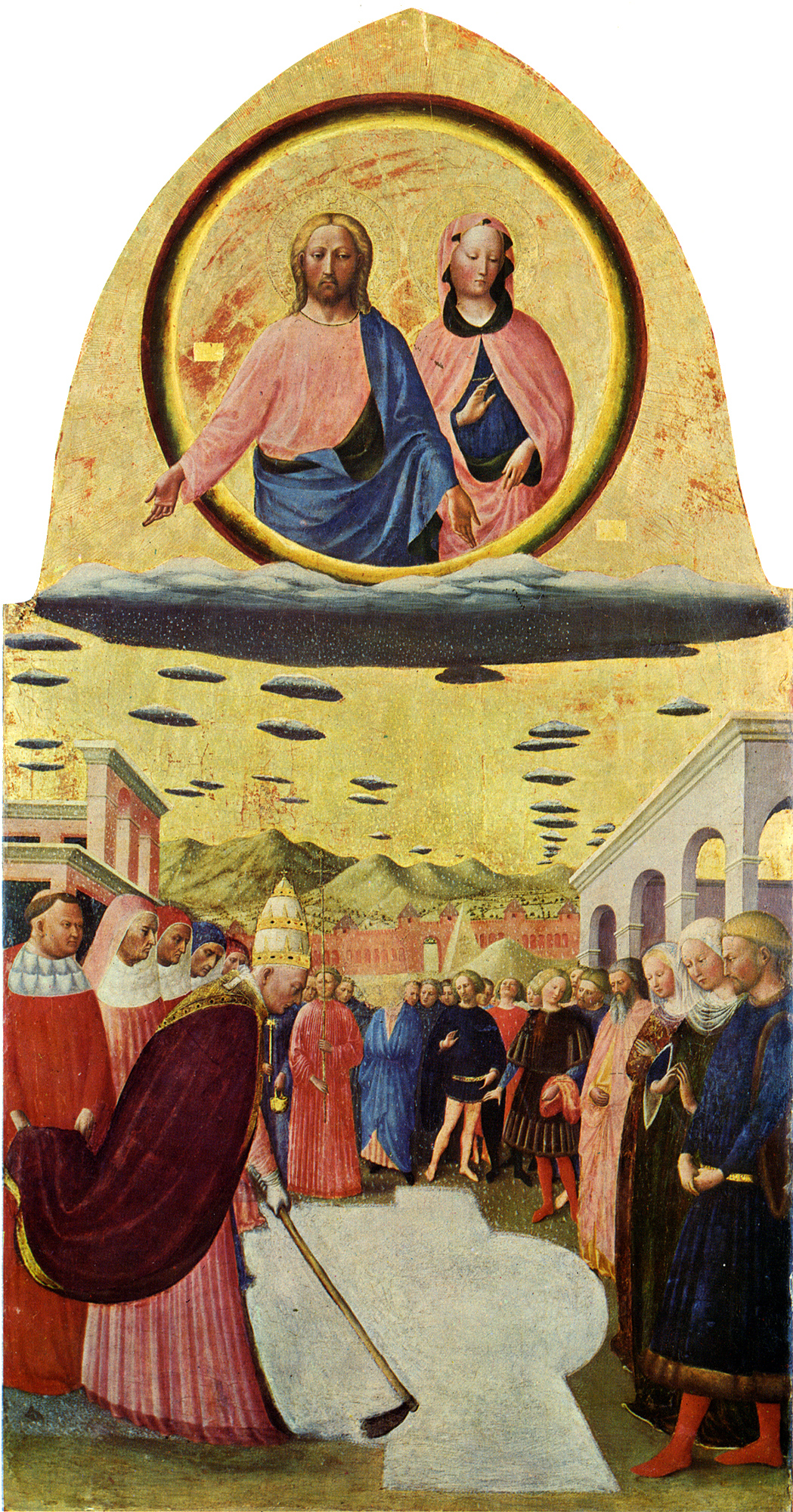
      Masolino, The Foundation of Santa Maria Maggiore, c1427-8

      The snow has been melting here and the passage of days has left Kline-like compositions on the ground mapping the departure of vehicles, the clearing of paths and the making of snowmen.  Looking out of the window now it is not clear why certain patches of snow remain, as if they have some special significance. Masolino's central panel for the Santa Maria Maggiore Polyptich shows Pope Liberius marking out the site of the future church after a miraculous summer snowfall on August 5th 352.  The snow had been predicted in a dream shared by the Pope and a rich Roman couple who wanted to donate their wealth to a worthy cause.  In Masolino's painting, snow floats through the golden sky beneath a fleet of clouds that resemble UFOs.  From the largest of them Christ and Mary look down and snowflakes fall more thickly on the place where the new building will rise, a permanent legacy of this fleeting phenomenon.  Later depictions of the legend by artists like Grünewald and Murillo treat the subject more naturalistically and less interestingly.  Today the miracle of the snow is recreated in Santa Maria Maggiore and other churches every year with a shower of flower petals.

      Saturday, December 18, 2010

      Steal softly thru snow


      We'll be raising a glass to the memory of Don Van Vliet / Captain Beefheart this evening.  The clip here shows the band in their final incarnation doing 'Ice Cream for Crow' and features examples of the paintings to which he would subsequently devote himself.  At 1:36 and 2:42, for example, you can see canvasses planted in the landscape that clearly inspired them.  Also, about two minutes in, the band start adding pot plants to the desert - a gesture that may well make some significant point about culture and landscape that I ought to be elaborating upon here.

      I saw an exhibition of Don Van Vliet's paintings in Brighton back in 1994.  I remember it was hard to be objective about them when you had 'I'm Gonna Booglarize You Baby' playing on a TV monitor in a corner.  The exhibition's introduction noted that 'for many years Van Vliet lived in the Mohave Desert before moving more recently to the Northern Californian coast and his palette, with its heavy greens, blues and ochres, is entirely reminiscent of the landscape he inhabits and his concerns for that environment, while his strong use of thick washes of black and white serve to delineate his own interior sensibilities.'

      London is completely black and white today, lying in thick cold snow, and has been reminding me of a Captain Beefheart song:

      Steal softly thru sunshine
      Steal softly thru snow
      The wild goose flies from winter
      Breaks my heart that I can`t go...

      Wednesday, July 7, 2010

      CHAPTER TWENTY-TWO -- WHITE DONE RIGHT


      Frosty Glow, 9" x 12" 


      (With thanks to The Pastel Journal where this was originally published, with additional material included here.)

      The painting looks washed out, as though someone poured bleach over it and left it in the sun too long. All the colors appear faded, like jeans after years of wear or an old flag left to disintegrate, a vague suggestion of once-bright colors. The overall effect is dull and flat. Chalkiness is a problem that can crop up in any medium, but is often found in pastel paintings, partly because of the abundance of pale colors that are available. The whitish, wishy-washy colors of a chalky painting suggest a lack of control over value, contrast and color.

      A high-key painting need not be bland and characterless. Instead it can celebrate the light by maintaining control of tones, using a range of values and the right contrasts for the subject. Although the darkest dark may only be a medium value in the final painting it must nevertheless present a selection of values leading to the lightest light.

      One way to defeat chalky color syndrome is to try two different challenges: First, paint an all-white subject using no actual white pastel. Second, paint a very high-key subject in which a medium value functions as the darkest dark. Each of these exercises will strengthen your understanding of how to control values while using colors. Value is the element that describes the shapes of objects and is the underlying abstraction of all painting, so increased awareness of value improves composition as well as color.

      WHITE WITHOUT WHITE

      Begin with an all-white subject, which may reside inside the composition, such as a white cloud or whitewater rapids, and work to create interesting colors hung on a sound tonal structure while maintaining a sense of whiteness. Because of the temptation to pick up pure, bright white, remove it from your palette and put it where you cannot see it. Good planning must lie behind your painting, in which you first create an arrangement of interesting values and shapes. In this challenge you need not limit the values. In fact, it’s best to design a strong tonal contrast of dark darks and an excellent range of middle values to use against the light colors to achieve the impression of whiteness. Don’t use bright white paper, which will simply allow you to replace the missing white with the color of the ground. Instead, choose a light value tone in a pleasing color to set the mood of the painting and establish its overall paleness. Do not allow the white subject to become simply black and white. Utilize colors to arrive at the proper tones. Many times an over-reliance on high contrast alone results in a chalky painting. Instead, a range of strong middle values accomplished via color will make an interesting all-white subject.

      Cold River Runoff, 9" x 17"

      How much color can you put into white? One of the most interesting aspects of white is that it’s made up of all colors in the light spectrum. Overlapping red, blue and green spotlights can make white light on a stage, as long as the colors are equally balanced. For the artist, this means white may be flavored with any color found in nature. Consider the color cast that varying light sources give to objects. Our sun is a yellow star and gives warmth to all colors seen in daylight. In shade, the blue of the sky influences all colors, so whites seen in daylight can generally be thought of as warm yellow in the sun and cool blue in shade. However, there are varying kinds of daylight. On an overcast day the light is often cool in color, having been filtered through clouds, while at sunrise or sunset the light is strikingly warm in color. Whites seen under these conditions can be darker shades of blue and green or warm, bright tones of red and orange. Moonlight, because it is so pale, bleeds all color from a scene, leaving ghostly grays in place of whites. Firelight and candlelight make white into hot red and orange. You’re free to select from an endless array of light colors because of the fact that white contains all colors.

      One particularly important tool to have on hand is a value finder. While there are many varieties, essentially this is a card printed with a scale of grays from black to white, each of which is pierced with an opening. This allows you to hold the card above a color, squint until your eye is almost closed and see where that particular color blends into its value of gray. For instance, you can hold the card above a photograph of clouds and perceive the lightest lights in the white of the billows, as well as the paler grays of the blue of the sky. There is no standard number assigned to values on the value finder. The number 10 does not always represent white. In fact, 10 might easily be called black, so disregard the actual number but understand that there is a scale of dark to light.

      White is by definition the lightest value in the palette. To paint white subject matter you must first realize that no other color can possibly approach white in lightness. Therefore the challenge is to build near-whites into the painting, using far more colors in the light range of your palette. Hold the value finder above the lightest values in your photograph or painting, noting that only white registers as the lightest light. Now find colors that are slightly -- very slightly -- darker than white. This may be only a pale pearl gray value. If your palette of colors is not strong in this light range, consider purchasing very pale blues, greens, yellows, peaches, pinks, lavenders and grays that you can use when very light values are needed. However, do not rely on light colors alone to make an effective painting of a white subject. You must structure a strong range of all values into the painting, and these too must be made using colors. Particularly important to the success of the white subject is the use of interesting middle tones, where the strongest color often resides. The strongest darks will also benefit from the use of colors.

      To check the values of your colors change a photograph to grayscale on your computer. This will allow you to clearly see how the colors translate into values. Check to make sure that your subject appears to be white in the grayscale version and that you have the proper array of values.

      MIDDLE VALUE AS DARK

      For another challenge, paint a subject that’s structured using mostly lighter values, such as a very sunny landscape. This is commonly referred to as a high-key painting. Use your value finder to establish the darkest dark in your painting as a medium or medium-dark value. High-key compositions must have an interesting variety of values between the lightest light and the darkest dark to avoid overly pale chalkiness, even if the darkest color is medium in value. Rather than relying on high contrasts of light and dark, look instead to color relationships. This will necessitate concentrated contrasts in color rather than a reliance on value alone. However, no painting can possibly divorce itself entirely from the issue of value, which is a basic property of color.
      Fog, 12" x 9"
      You’ll need to select a value for your ground. Beginning with a middle value establishes the darkest tone for the entire painting. The test is to rely on medium values as the darkest darks in a painting of a light subject. It helps to create a careful study or underdrawing to establish a range of values from medium to light. In this painting you are allowed to use white for the palest value, however, after your experiments painting all-white-with-no-white you most likely will find that white seems somewhat dead, giving a ghostly chalkiness to the piece. The idea here is to use vibrant colors that bounce and play together, achieving an overall high-key value structure that’s nonetheless colorful. The effect may be one of intense heat, giving the impression of a hot summer day or powerful sunlight warming everything in the scene, even when predominantly cool colors are used, or may result in the cool, pale effect of fog or early morning light. Confirm your limited value range by laying your value finder down alongside the painting, or put a strong dark line next to the image against which you can check your colors so that you can more easily identify darks that are becoming too deep for the limited range you’ve established. Step back frequently to see that the intensity of colors you’re using approximates the light on the subject.

      CONTROL

      As you conduct each of these exercises your control over value will increase, as will your understanding of how to use colorful lights. You will begin to see the color of light in all its many hues, and realize that pale color does not mean lack of color. Chalky paintings with an insipid, dull look will soon give way to lyrical colors in pale values that vibrate together in a well-planned structure of values.

      Sanctuary, 12" x 9"