Showing posts with label gardens. Show all posts

Saturday, October 15, 2011

Daphnis and Chloe

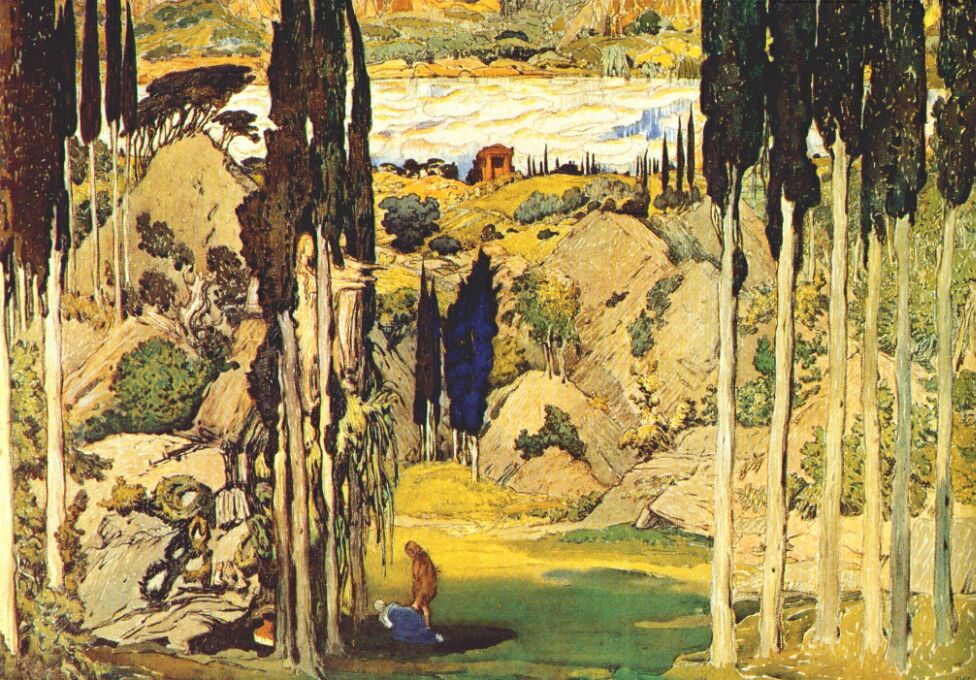
There is a delightful sense of freedom in the lives of Daphnis and Chloe, as the young goatherd and shepherdess grow to love each other in the woods and fields of Lesbos.  Daphnis (Δάφνις) is named after the laurel bush and Chloe (χλόη) means the fresh green grass of spring.  They herd their animals together, share their food and milk and wine; Chloe picks stems of asphodel to make little cages for grasshoppers, Daphnis binds together slender reeds and learns to play the pan pipes.  In the summer they listen to the singing of rivers, the wind in the pines and the sound of the cicadas.  Two places in particular are special to them: a statue of Pan underneath a pine tree and, nearby, a cave dedicated to the Nymphs, from which a spring rises whose stream nourishes a meadow of soft grass. There is some hard work - for Chloe the wearisome job of churning milk - but after it is done the lovers have time to bathe, pick fruit and lie together kissing under an oak tree. 

Léon Samoilovitch Bakst, set design for Ravel's Daphnis et Chloë, 1912

As you read about the passing of the seasons and the growing love of Daphnis and Chloe, it is easy to forget that the landscape Longus is describing is actually made up of the estates of rich men, living away in the city, and that Daphnis and Chloe are actually slaves.  Daphnis works on 'a very splendid property: it had mountains abounding in game, plains fertile in wheat, gentle slopes with vineyards, pastures with flocks, and a long stretch of shore where the sea broke on the softest sand.'  The last part of the novel, Book 4, begins with the news that the Master is returning to look over his property, including a large pleasure ground, containing cypresses, laurels, pines, and plane trees, fruit trees (apple, pear, pomegranate), beds of roses, lilies and hyacinths, and wild flowers: violets, narcissi, pimpernels.  In a description which reads like a blueprint for eighteenth century landowners, Longus writes that 'from there, a wide prospect opened over the plain and the sea beyond, and it was possible to see the peasants minding their flocks and herds, and the ships scudding across the bay - that view was another of the delights afforded by the pleasure-ground' (trans. Ronald McCall).

In the end, it turns out (to no great surprise) that Daphnis and Chloe are not the children of peasants - both had been exposed at birth by their real parents, suckled by a goat and a sheep, discovered and then brought up in the countryside.  But after they marry they return to their rustic idyll and own sheep and goats in great number.  They name their children Philopoeman ('friend to shepherds') and Agele ('herd').  It is a happy ending but to a modern reader it seems a shame that they go on to 'beautify' the Nymphs' cave with pictures and 'let Pan have a temple for his home instead of the pine tree'.  Such artifice is of course in keeping with the pastoral genre and indeed the entire novel is a kind of ekphrasis: its preface explains that Daphnis and Chloe is a story the author saw one day while he was out hunting in Lesbos, depicted in a painting, hanging in a grove sacred to the Nymphs.
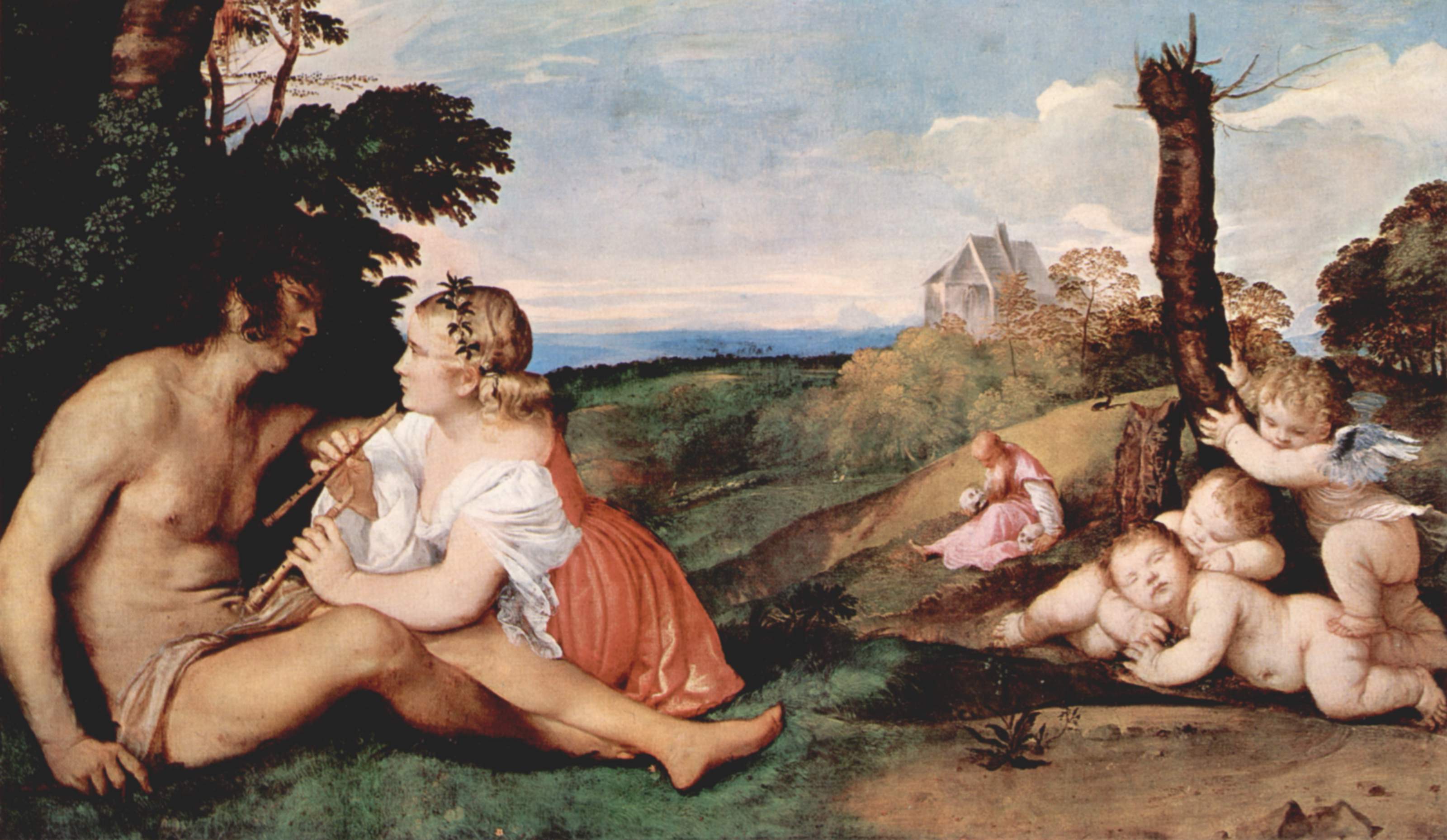
Titian, The Three Ages of Man, c1512
It has been suggested that this may show scenes from Daphnis and Chloe

There are other things I could say about landscape in relation to this book, but I'll confine myself to noting that there are three points in the story where aetiological myths are poetically retold to explain natural phenomena: the call of the wood pigeon, the origin of pan-pipes and the source of echoes. Chloe first experiences an echo while listening with Daphnis to the singing from a passing boat, down below them in a deeply curving bay.  Behind the level pasture where they stand there is a hollow coomb which receives the sounds and 'like a musical instrument' repeats them back again.  Chloe promises Daphnis ten kisses if he will tell her the origin of this phenomenon and so he begins his story, explaining that 'there are many kinds of nymphs - ash-tree nymphs, called Meliae, oak-tree nymphs, called Dryads, and nymphs of the marshes, called Heleioi. All are fair, all are makers of music.  Echo was born the daughter of one of these ... the Muses taught her to play the pan-pipes and the flute, to sing to the lyre and the cithara.'  She shunned mankind but Pan grew jelous and drove the shepherds and goatherds mad so that they tore her to pieces, still singing.  Earth gave these shreds of music shelter and now they are able to portray the sounds of people and animals, just as Echo once had done.  'When Daphnis ended his story, Chloe gave him not ten but ten-score kisses - for the echo had all but repeated what he said, as though to witness that he told no lie.'

Monday, August 29, 2011

Rain-saturated, churning, chanting thunder

The education in Latin shared by English gentlemen was obviously an influence on their landscape gardening.  As Tim Richardson puts it in The Arcadian Friends, 'from the schoolroom to the garden, Virgil set the scene, Horace set the tone, Cicero inspired the political iconography, Pliny extolled the creature comforts, and Ovid directed the sensual fantasy narrative.' Beyond this basic pantheon it is interesting to consider any other writers who touched on landscape themes or inspired future landscape thinking.  One example, less well-known today, was Persius (Aulus Persius Flaccus) who lived in Rome and died young (his dates were 34-62).  His Sixth Satire was translated by Dryden in the 1690s.  In it, a land-owner rejoices in his life free from the concerns of business and state: 'here I enjoy my private Thoughts' and do not care if crops fail or neighbouring farmers have 'a larger Crop than mine.' However, the poem is not concerned with farming or landscape specifically, its general theme is 'an admirable common-place of Moral Philosophy; Of the true Use of Riches'.

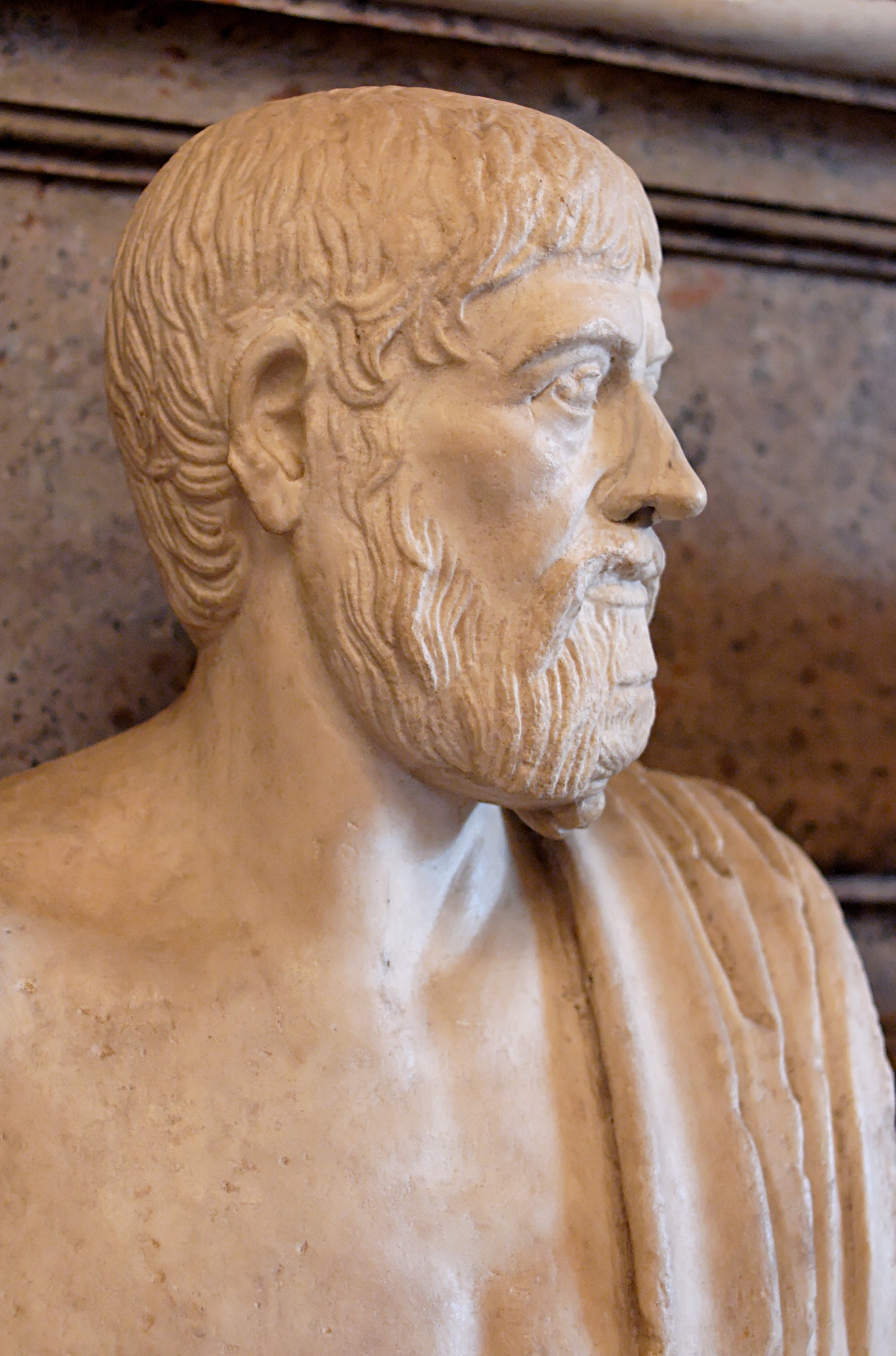
The erudite Joseph Addison had read more widely than these Latin writers and in a piece for The Spectator in 1712 showed off his knowledge of Greek: 'my compositions on gardening are altogether after the Pindarick manner, and run into the beautiful wildness of nature, without affecting the nicer elegancies of art.'  According to Richardson, 'Pindar's verse mingles an admiration of the grandeur of raw nature with an ability to complement its changefulness and variety through elegant expression.'  This makes him sound like an interesting wilderness poet, although as with Persius there is no direct writing on landscape in his Odes.  Addison was probably thinking more about the way Pindar wrote. Horace, for example, compared Pindar's writing to a wild landscape: 'a river bursts its banks and rushes down a mountain with uncontrollable momentum, rain-saturated, churning, chanting thunder – there you have Pindar's style...'

Pindar (Roman copy after a Greek original of the 5th century BCE)

Sunday, August 28, 2011

The Valley of the Shadow of Death

Jonathan Tyers, the owner of Vauxhall Pleasure Gardens, had his own private estate at Denbies in Surrey.  There he named an 8-acre woodland 'Il Penseroso' after Milton's poem - perhaps, as Tim Richardson says in his book The Arcadian Friends, Tyers 'viewed Vauxhall Gardens as its equivalent, the more jocund L'Allegro' and the melancholy woodland as 'a kind of penance for the jolly hedonism of Vauxhall.'  In this wooded part of the garden there was a hermitage called the Temple of Death which contained, in addition to a memorial to garden designer Lord Petre, a model of a white raven and a clock that chimed every minute, to remind visitors of the transience of life.  Black leather-bound copies of Edward Young's Night Thoughts and Robert Blair's The Grave were available for perusal on a table.  Beyond the hermitage was a gateway with posts made from upright coffins, 'its arch surmounted by a pair of human skulls (reputedly real - one belonging to a highwayman, the other a prostitute's)'.  This was the entrance to the Valley of the Shadow of Death.  Here the two artists Tyers had previously employed at Vauxhall were asked to decorate the interior of a temple.  Either side of an allegorical statue by Louis-François Roubiliac were paintings by Francis Hayman: The Death of a Christian (peaceful and accompanied by an angel) and The Death of an Unbeliever (about to be speared by a leering skeleton).  Richardson concludes that 'any visitors who arrived thinking they might have an amusing time with the happy-go-lucky proprietor of Vauxhall Gardens were in for a disappointment.'

William Blake, illustration intended for the 1805
publication of Blair's poem 'The Grave'

Monday, May 9, 2011

The Englishman's Home

Garden on the roof of Queen Elizabeth Hall

To the South Bank Centre yesterday where the sixtieth anniversary of The Festival of Britain is commemorated in themed areas 'filled with pop-up structures, artworks, films and exhibitions. Each of these ‘lands’ is themed according to one of the most significant themes in 1951: Land, Power & Production, Seaside and People of Britain.'  These additions may not do much for the architecture of the site but they are clearly going to be popular with visitors and add to the vibrancy you always sense there in summer.  We had a drink in the garden installed on the roof of the Queen Elizabeth Hall which features 'a lush lawn sprinkled with daisies and fruit trees that conjure up a country orchard. With over 90 varieties, the wildflower area is a celebration of the diversity of British flora, attracting insects and butterflies while providing nectar for bees from the hives on Royal Festival Hall’s roof. The garden has a patchwork of vegetable plots – a roof, after all, can be both productive and attractive. And a rustic pergola, clothed with sweetscented climbers, crowns a bridge to the Hayward Gallery punctuated with drought-resistant plants.'

John Piper's mural for the Festival of Britain, 
The Englishman's Home, 1951

Inside the QEH you can see the mural John Piper created for the Festival, comprising 42 separate panels with English buildings that he particularly loved. The Englishman's Home was later installed on the wall of Harlow Technical College's main assembly room, where it remained until the college re-located in 1992.  According to Frances Spurling's recent book on him, Piper was assisted in painting the mural by Joy Mills, who Myfanwy later described as "one of John's girls" and who was 'aware that John found her very attractive, and that Myfanwy knew this.'  Also around the QEH there are other 'Land' installations - a giant Urban Fox, Ben Kelly’s walled Enclosure, and a coal chamber, Black Pig Lodge, by Heather and Ivan Morison (which was roped off for repairs).  Apparently you can also hear 'a collage of sounds taken from across Britain’s landscape through the seasons', which 'reverberates across the incongruous setting of Southbank Centre’s concrete terraces and walkways.  Using an array of speakers and audio tracks, Marcus Coates and Geoff Sample have recreated the acoustic atmospheres of rural Britain.'  I couldn't actually hear anything but possibly didn't locate the correct place to stand - the installations are around until September so no doubt I'll be back at some point.